
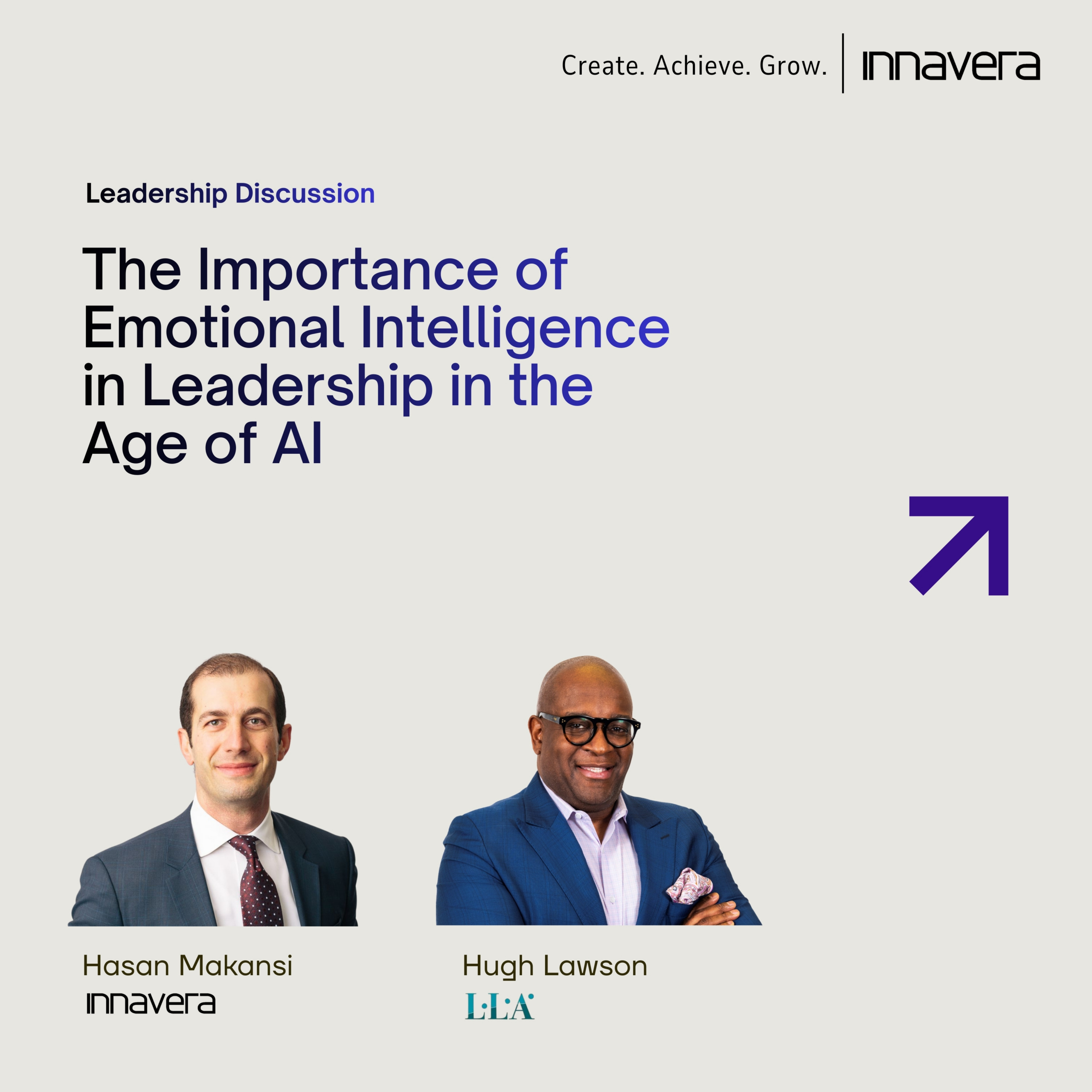

By Hasan Makansi and Hugh Lawson
We recently sat down for a conversation that began, as many do today, with artificial intelligence. It did not take long for the discussion to move beyond technology itself and into the realities leaders are facing as AI reshapes organizations, roles, and expectations. What emerged was a shared recognition that while AI is transforming how work is done, its most significant impact is being felt in how leadership is practiced. This article captures the reflections, questions, and insights that surfaced from that conversation.
When Technology Accelerates, Leadership Slows the System
One of the first themes that surfaced was pace.
AI is accelerating how decisions are made, how work is done, and how performance is measured. Leaders are expected to move faster, process more information, and act with confidence in increasingly ambiguous conditions.
Yet the human system does not accelerate in the same way.
Teams need time to understand what change means for them. People need context, reassurance, and space to adapt. When leadership mirrors the speed of technology without attending to the emotional impact, misalignment follows quickly.
This is where emotional intelligence becomes essential. Not as a counterweight to AI, but as the stabilizing force that allows organizations to absorb change without fracturing trust or engagement.
What Leaders Are Actually Struggling With
As the conversation deepened, it became clear that resistance to AI is often misdiagnosed.
Most people are not resistant to technology. They are anxious about relevance, value, and uncertainty. They are trying to understand where they fit in a system that increasingly emphasizes automation, data, and efficiency.
Leaders feel this pressure as well. They are navigating expectations from boards, investors, and markets, while also managing the emotional undercurrents within their organizations.
Emotionally intelligent leadership shows up in how these tensions are handled. In the ability to acknowledge uncertainty without undermining confidence. In the discipline to listen rather than rush to reassure. In the judgment to know when speed helps and when it harms.
Emotional Intelligence as a Strategic Capability
Throughout the discussion, one point kept resurfacing. Emotional intelligence is often described as interpersonal, but in practice it is deeply strategic.
Leaders with strong EQ demonstrate:
- Composure under pressure, particularly when AI-driven change creates ambiguity
- Credibility built through honest communication, not polished narratives
- The ability to sustain engagement even as roles and expectations evolve
- A leadership presence that invites contribution rather than compliance
These qualities directly influence performance, innovation, and resilience. They are not abstract traits. They shape how decisions are made and how change is experienced across the organization.
AI and EQ Are Not Competing Forces
Another important thread in the conversation was the false tension often created between AI and emotional intelligence.
AI is exceptionally good at identifying patterns, optimizing processes, and generating insight at scale. What it cannot do is interpret emotional context, understand human motivation, or weigh ethical trade-offs in complex social systems.
That responsibility remains human.
Leaders who combine AI capability with emotional intelligence are better positioned to make decisions that are not only efficient, but sound. Data can inform. EQ determines response.
The most effective leadership models emerging today do not privilege one over the other. They integrate both.
The Cost of Ignoring the Emotional System
The conversation also touched on a broader pattern being observed across industries. Emotional fatigue is rising. Burnout is becoming normalized. Engagement is eroding quietly.
These trends are not disconnected from AI adoption. They are amplified by it.
When organizations focus exclusively on technological capability without investing in emotional capacity, performance may improve in the short term, but sustainability suffers. Talent leaves. Trust weakens. Leadership pipelines thin.
Emotionally intelligent leadership is not a wellness initiative. It is a resilience strategy.
What This Means for Leaders Now
The discussion did not end with prescriptions, but with a shared conclusion.
Leaders navigating the AI era must develop the ability to hold two realities at once. To push innovation forward while staying deeply attentive to the human experience of change.
This requires intention. It requires self-awareness. It requires leaders to model the behaviours they want to see, particularly under pressure.
Most organizations already have the intelligence needed to adapt successfully to AI. What determines outcomes is whether leadership can create the conditions for that intelligence to surface.
A Final Reflection
AI will continue to evolve. Its capabilities will expand. Its influence will deepen.
Leadership, however, remains rooted in human judgment, emotional awareness, and the ability to guide people through uncertainty.
This article is not a conclusion, but an invitation. To reflect on how leadership is changing. To question what capabilities matter most now. And to recognize that in the age of artificial intelligence, emotional intelligence is not diminished. It is elevated.